
|
Electrical Circuits And Related Theories: Basic To Advanced
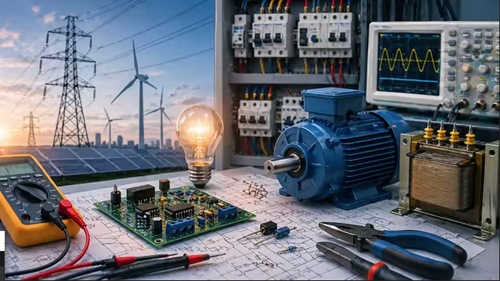 Electrical Circuits And Related Theories: Basic To Advanced Published 4/2026 MP4 | Video: h264, 1920x1080 | Audio: AAC, 44.1 KHz, 2 Ch Language: English | Duration: 10h 37m | Size: 12.73 GB What you'll learn Students will learn to apply the fundamental laws such as Ohm's Law, Kirchhoff's Laws, and basic circuit elements to analyze simple electrical circuits. Students will learn to analyze and solve complex electrical networks using techniques like mesh analysis, and source transformation. Students will learn to analyze series and parallel circuits to determine equivalent resistance, current distribution, and voltage drops across elements. Students will understand several basic electronic devices and circuits, such as PN junction diodes, rectifiers, and Zener diode voltage regulators. Requirements Basic Mathematics Skills and Fundamental Physics Knowledge Description This course offers a thorough look at electrical circuits and the theories that explain how they work, starting with basic concepts and progressing to more advanced analysis methods. Beginning with basic concepts such as Ohm's Law, Kirchhoff's Laws, and network theorems, the course builds a strong foundation in circuit analysis. Fundamental circuit configurations, including series and parallel circuits, are studied in detail. Students learn how current, voltage, and resistance behave in these networks, forming the basis for analyzing and simplifying complex circuits. Students will develop strong problem-solving skills using systematic techniques such as nodal analysis, mesh analysis, and source transformation. The course also introduces essential electronic devices and applications, including the PN junction diode, rectifier, Zener diode, and Zener diode as a voltage regulator, focusing on their characteristics and real-world circuit implementations. The course continues with AC circuit analysis, transient response, resonance, and the operation of complex networks. It is important to have both a theoretical understanding and the ability to solve real-world problems. By the end of the course, learners will be equipped to analyze, design, and interpret a wide range of electrical and electronic systems, preparing them for advanced studies and professional practice in electrical and electronics engineering. Who this course is for Undergraduate engineering students, Diploma and polytechnic students Цитата:
|
| Часовой пояс GMT +3, время: 03:54. |
vBulletin® Version 3.6.8.
Copyright ©2000 - 2026, Jelsoft Enterprises Ltd.
Перевод: zCarot