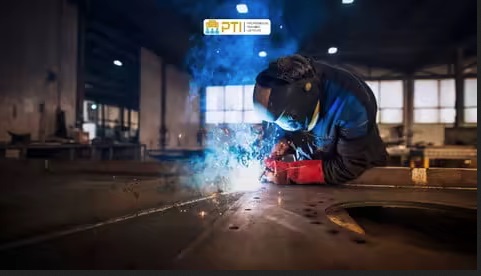
Engineering Aspects Of Welding Fundamentals
MP4 | Video: h264, 1920x1080 | Audio: AAC, 44.1 KHz
Language: English | Size: 7.25 GB | Duration: 5h 30m
Master Welding Engineering: Processes, Metallurgy, Codes, Inspection & Advanced Manufacturing Techniques
Understand all major welding processes and their applications
Learn welding metallurgy and material behavior during welding
Interpret and apply AWS, ASME, API, and ISO codes
Design welding joints and control distortion effectively
Perform weld inspection and NDT techniques
Develop WPS (Welding Procedure Specification) and PQR
Identify weld defects and apply corrective measures
Understand safety standards and welding hazards
Explore advanced welding technologies and automation
Analyze real-world welding engineering case studies
Requirements
Basic understanding of engineering fundamentals
High school mathematics (algebra, geometry, trigonometry)
Basic physics knowledge (heat, electricity)
Familiarity with technical drawings
Interest in welding and manufacturing
Safety awareness mindset
Description
This course contains the use of artificial intelligence.This comprehensive professional course delivers a complete and practical understanding of welding engineering, covering everything from foundational principles to advanced industrial applications. Designed with a strong engineering perspective, it integrates theory, real-world practices, and modern technological advancements to prepare learners for professional roles in welding, manufacturing, and quality control industries.Learners will explore all major welding processes including SMAW, GMAW (MIG), GTAW (TIG), FCAW, and SAW, along with a deep dive into welding metallurgy, heat-affected zones (HAZ), phase transformations, and material behavior under thermal cycles. The course also emphasizes welding design principles, joint preparation, distortion control, and procedure qualification.A major focus is placed on industry standards such as AWS, ASME, API, and ISO, enabling learners to confidently interpret codes and ensure compliance in real-world projects. Additionally, students will gain hands-on knowledge of non-destructive testing (NDT) methods like radiographic testing, ultrasonic testing, magnetic particle inspection, and dye penetrant testing.The course further explores modern advancements including robotic welding, friction stir welding, laser welding, and Industry 4.0 integration. Through global case studies and engineering examples, learners will develop problem-solving skills applicable to real industrial challenges.About Professional Training InstituteProfessional Training Institute is dedicated to delivering industry-relevant, skill-focused education designed to bridge the gap between theoretical knowledge and real-world application. Our courses are structured by experts to ensure learners gain practical expertise, career-ready skills, and globally recognized knowledge across engineering and technical domains.
Mechanical and manufacturing engineering students,Professional welders seeking advancement,Welding inspectors and NDT technicians,Welding engineers and supervisors,Construction and fabrication professionals,Industrial and manufacturing engineers,Maintenance and plant engineers,Technical sales engineers in welding industry






 Engineering Aspects Of Welding Fundamentals