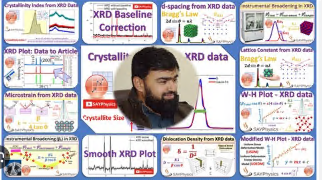
 X-Ray Diffraction (xrd) Data Analysis And Interpretation
Last updated 7/2025
MP4 | Video: h264, 1920x1080 | Audio: AAC, 44.1 KHz, 2 Ch
Language: English | Duration: 4h 42m | Size: 4.54 GB
XRD Data Analysis in OriginPro, WinXPow and GSAS-II
What you'll learn
Learn to install and use OriginLab and GSAS-II software for XRD data plotting and analysis efficiently.
Master baseline correction, smoothing, refinement, and deconvolution of peaks for accurate data interpretation.
Understand advanced techniques like, indexing, crystallite size calculation, lattice constants, microstrain analysis, and Williamson-Hall plot.
Acquire proficiency in GSAS-II software for XRD data plotting, refinement, and peak indexing for crystallographic studies.
Requirements
1. Basic understanding of XRD (X-ray Diffraction) principles.
2. Familiarity with fundamental data analysis concepts and software usage in scientific research.
3. Prior knowledge of crystallography and materials characterization techniques is beneficial.
4. Access to a computer with internet connectivity to download and install the required software tools (Origin, GSAS-II).
Description
This comprehensive course on Advanced XRD Data Analysis provides step-by-step guidance through a series of instructional video tutorials. Participants will learn how to effectively process, analyze, and visualize XRD and FTIR data using Origin and GSAS-II, two powerful software tools widely used in scientific research and industry.
The course covers fundamental techniques such as baseline correction for XRD in Origin, smoothing XRD graphs, deconvoluting peaks, calculating Full Width at Half Maximum (FWHM), finding the area under curves, and plotting XRD data for publication. Participants will gain essential skills in determining crystallite size, lattice constants, microstrain, and dislocation density from XRD data using Origin. Additionally, the course explores advanced topics like adding negative hkl indices to XRD graphs, subtracting instrumental broadening, and utilizing Williamson-Hall plots for crystallite size and microstrain analysis.
Participants will also receive instructions on installing and utilizing GSAS-II, a free XRD data analysis software. The course covers simple plotting and refinement of XRD data in GSAS-II, finding and indexing XRD peaks, and utilizing GSAS for efficient XRD data analysis.
By the end of this course, participants will have a strong understanding of advanced XRD data analysis techniques, enabling them to conduct in-depth analyses and generate insightful visualizations for their research and applications.
Who this course is for
1. Students and Researchers in Materials Science and Chemistry
2. Professionals in Analytical Laboratories
3. Academic Professionals and Educators
4. Anyone Interested in Advanced Data Analysis






 X-Ray Diffraction (xrd) Data Analysis And Interpretation