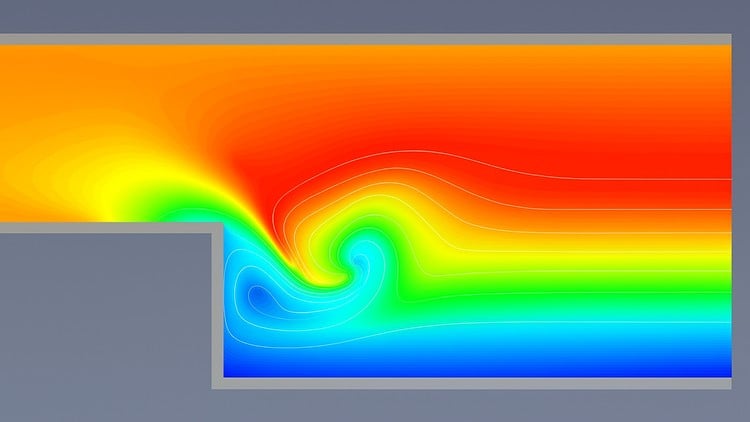
Cfd With Openfoam: Pitzdaily Case
Last updated 9/2025
MP4 | Video: h264, 1920x1080 | Audio: AAC, 44.1 KHz, 2 Ch
Language: English | Duration: 58m | Size: 306 MB
Learn Turbulence Modeling and Simulation with the Classic pitzDaily OpenFOAM Tutorial
What you'll learn
Understand the physics of turbulent channel flow with expansion.
Understand the physics of turbulent channel flow with expansion.
Set up and run the pitzDaily tutorial in OpenFOAM.
Learn about turbulence models (k-ε, k-ω, etc.) and when to use them.
Requirements
No programming experience needed.
Description
Step-by-Step Guide to Geometry, Case Setup, Turbulence Models, and Post-Processing in OpenFOAMThe pitzDaily case is one of the most widely used benchmark tutorials in OpenFOAM, designed to study turbulent flow over a sudden expansion in a channel. Despite its simple geometry, this case captures essential flow features such as separation, recirculation, and reattachment, making it an ideal starting point for learning turbulence modeling in CFD.In this course, you will learn how to set up, run, and analyze the pitzDaily case step by step. We begin with the fundamentals of the geometry and mesh, followed by boundary conditions and solver setup. A key focus is placed on turbulence models-including k-ε, k-ω, and Spalart-Allmaras-explaining their theoretical basis and practical implementation in OpenFOAM. You will then run simulations using simpleFoam and learn how to monitor convergence and solver stability.Post-processing is performed in ParaView, where you will visualize velocity fields, pressure distributions, and turbulent structures. You will also learn how to extract quantitative data and create high-quality visualizations for reports or research.By the end of the course, you will have the confidence to handle turbulent simulations in OpenFOAM and extend the knowledge gained from pitzDaily to more complex real-world engineering problems.
Who this course is for
Beginner Learners of OpenFOAM






 Cfd With Openfoam: Pitzdaily Case