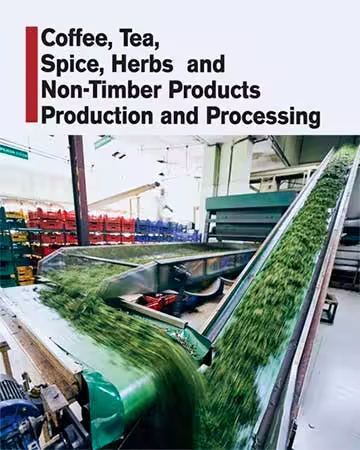
2023 | ISBN: 1984679260 | English | 344 pages | True PDF | 21 MB
In Latin America, Africa, and Asia, coffee is an extremely important agricultural commodity, produced in over 80 tropical countries, with an estimated 125 million people depending on it for their livelihoods, producing about nine million tons of green beans every year. In recent years, coffee production has experienced changes in its economics, with prices on the international market declining and input costs increasing. Nevertheless, specialty coffee is in high demand at the moment. As a means of making coffee production sustainable, attention needs to be paid to improving the quality of the coffee through sustainable, environmentally friendly cultivation practices, which in turn can lead to higher returns for producers. The mechanical processing of spices and herbs merely alters their shape while ensuring that any negative impact is kept to a minimum. Spices and herbs require complex processing chains, making size reduction technology one of the most challenging tasks. It is important to note that each process is unique and depends on both the customer's needs and the product's diversity. A spice, medicinal herb, dried vegetable, or root's hardness, size, color, oil content, shear resistance, and viscosity play a significant role. Additionally, non-timber forest products (NTFPs) include products and services other than wood produced in forests that are subject to quality fluctuations due to their natural origin. The forest is home to a variety of NTFPs, including medicinal plants, resins, gums, essences, bark and fiber, fruits, and nuts. This book contains seven chapters.






 Coffee, Tea, Spice, Herbs And Non-Timber Products Production And Processing