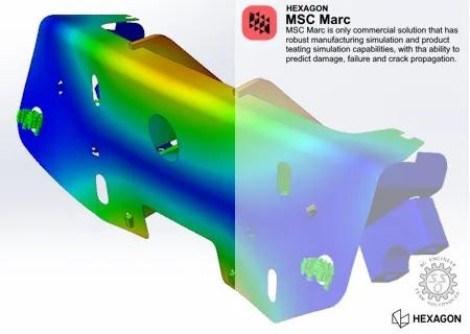
 Hexagon MSC Marc 2025.2 | 1.7 Gb
Hexagon is pleased to announce the release of
MSC Marc 2025.2, with highlights like unit-aware postprocessing, improved control over RBE2s and RBE3s, and more.
MSC Marc 2025.2 Release Highlights
-
Interpret results accurately: Mentat displays units consistently during post-processing, whether you're viewing model plots, history plots, or path plots.
-
Take more control over RBEs: Easily show or hide, quickly identify, and select RBE2 and RBE3 elements. They are also visible during postprocessing.
-
Do more with the user material subroutine: The UMATERIAL subroutine now supports shells, beams, anisotropy, and tables. Reuse Abaqus UMAT subroutines with minimal or no changes to streamline workflows.
-
Take advantage of enhanced contact modelling: The hybrid node-to-segment contact method now enables user-defined separation behaviour, and glued contact with load-controlled rigid bodies results are more accurate.
Unit-aware post-processing in Mentat
Marc 2025.2 introduces comprehensive unit-awareness throughout the postprocessing workflow. With these enhancements:
- Marc writes the unit system of the job to the results file, making it fully unit-aware.
- When performing analyses that read data from a results file, Marc checks whether the unit system of the results file matches that of the input file. If a mismatch is detected, an error is issued to prevent inconsistencies.
- The PyPost module and PLDUMP2000 utility now support unit-aware result files.
- Upon opening a unit-aware results file, Mentat automatically sets the model unit system to the unit system contained in the file. This system cannot be redefined or changed during post-processing.
- After opening a units-unaware results file, users may define the model unit system.
- For model result plots (scalar, vector, tensor, beam diagram, curve distance, surface distance), Mentat displays applicable units in legends and headers.
- For path plot, history plot, and generalised XY-plots, Mentat displays units in both X and Y axes titles.
- The global post variables menu shows units for each result quantity.
- Mentat writes units of each parameter to the report file.
- Additional unit-related enhancements apply to tables, generalised XY-plots, the distance command, and several other commands.
These updates significantly improve result clarity and confidence, enabling engineers to work more efficiently and, eventually, reduce the risk of unit-related mistakes.
History and model plots of a pipe connector model showing SI(mm) units
User experience enhancements with RBEs
A significantly more intuitive and streamlined experience with RBE2s and RBE3s improves both model setup and result validation.
- Hide or show RBEs directly from the Mentat model navigator for better model visualisation.
- Select RBEs from the viewport using the selection control menu and manage their visibility.
- Create RBE sets using the model navigator or the set control menu.
- Identify RBE sets through the model navigator's right-click menu or the identification menu.
- Display RBEs during postprocessing. (only supported for .t16 and .t19 result files, and when the job does not involve global remeshing or DDM)
These improvements greatly enhance the overall user experience when dealing with RBE2 and RBE3 elements in both pre- and post-processing. Users can now easily verify link definitions during model creation, after job completion, or even while simulations are still running.
Pipes connector model with identification of RBE2 and RBE3 sets
UMATERIAL subroutine enhancements
The user material framework introduced in Marc 2025.1 gives you more options and improves interoperability in version 2025.2.
- Use tables for defining material properties variations with variables such as temperature or time.
- Use plane stress, beam, and truss formulations.
- Add material anisotropies and orientations.
- Reuse existing Abaqus UMAT subroutines for Marc analysis with the new external user material framework.
Companies, research institutes, and universities that have already developed Abaqus UMAT subroutines for simulating advanced material behaviours can now use them with minimal to no modification in Marc analyses. This is achieved by using the Abaqus UMAT file directly in Marc.
User-defined material menu when the Abaqus UMAT type is selected
Contact modelling improvements
The hybrid node-to-segment contact method delivers greater robustness and versatility in contact simulations:
- Accurate handling of user-defined separation force or stress provides improved control over contact behaviour in specialised use cases.
- Improved glued contact behaviour across a broader range of scenarios offers robust handling of glued contact with load-controlled rigid bodies, enhancing stability in complex models.
- Major improvements to stress-free initial contact and gap/overlap retention are particularly beneficial for analyses involving tetrahedral elements.
The improvements deliver more robust, versatile contact simulation capabilities for demanding applications.
MSC Marc is a powerful non-linear finite-element analysis solution to accurately simulate the product behaviour under static, dynamic, and multi-physics loading scenarios. Marc is ideal for product manufacturers looking for a robust nonlinear solution. It has capabilities to elegantly simulate all kinds of nonlinearities, namely geometric, material and boundary condition nonlinearity, including contact. Marc is the only commercial solution that has robust manufacturing simulation and product testing simulation capabilities, with the ability to predict damage, failure and crack propagation. This, combined with its multi-physics capabilities can help you couple thermal, electrical, magnetic and structural analyses, Marc is the complete solution that can address all your nonlinear simulation requirements.
Revolutionizing Advanced Non-Linear Simulation: Hexagon's Marc Solver Now on the Cloud
This webinar explores how the combination of SimScale's cloud-native simulation tools with Hexagon's Marc unlocks new levels of engineering efficiency, helping accelerate product innovation for companies worldwide.
Hexagon is a global leader in sensor, software and autonomous solutions. We are putting data to work to boost efficiency, productivity, and quality across industrial, manufacturing, infrastructure, safety, and mobility applications. Our technologies are shaping urban and production ecosystems to become increasingly connected and autonomous - ensuring a scalable, sustainable future. MSC Software, part of Hexagon's Manufacturing Intelligence division, is one of the ten original software companies and a global leader in helping product manufacturers to advance their engineering methods with simulation software and services.
Owner: Hexagon AB
Product Name: MSC Marc
Version: 2025.2
Supported Architectures: x64
Website Home Page : https://hexagon.com/
Languages Supported: english
System Requirements: Windows *
Size: 1.7 Gb
Added by 3% of the overall size of the archive of information for the restoration
No mirrors please






 Hexagon-MSC-Marc-2025