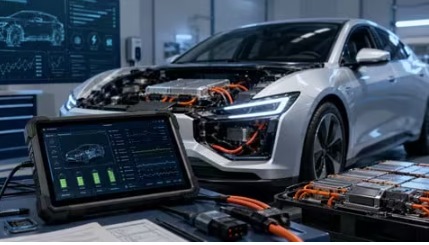
 Electric Vehicle Diagnostics
MP4 |
Video: h264, 1280x720 | Audio: AAC, 44.1 KHz
Language: English |
Size: 1.15 GB |
Duration: 3h 0m
# Electric Vehicle Diagnostics
**Level:** Beginner to Intermediate
**Duration:** 20-40 Hours (Self-paced)
## Course Overview
Electric Vehicle (EV) Diagnostics focuses on identifying, analyzing, and resolving faults in electric vehicles using diagnostic tools, software, and electrical testing techniques. The course covers high-voltage safety, battery systems, electric motors, charging systems, power electronics, and communication networks.
> **Safety Note:** EVs contain high-voltage systems (often 400-800 volts or higher). Only trained and qualified personnel should perform work on energized high-voltage components. Always follow manufacturer procedures and use appropriate personal protective equipment (PPE).
---
# Learning Objectives
By the end of this course, you will be able to:
* Understand EV architecture and components.
* Follow high-voltage safety procedures.
* Use diagnostic scan tools effectively.
* Read and interpret Diagnostic Trouble Codes (DTCs).
* Diagnose battery, motor, inverter, and charging system faults.
* Analyze CAN bus communication issues.
* Perform basic diagnostic workflows and document findings.
---
# Module 1: Introduction to Electric Vehicles
### Topics
* Types of EVs
* Battery Electric Vehicles (BEVs)
* Plug-in Hybrid Electric Vehicles (PHEVs)
* Hybrid Electric Vehicles (HEVs)
* Advantages and limitations
* Basic EV architecture
---
# Module 2: High-Voltage Safety
### Topics
* Electrical hazards
* PPE requirements
* Lockout/Tagout (LOTO)
* Verifying absence of voltage
* High-voltage disconnect procedures
* Emergency response basics
---
# Module 3: EV Components
Study:
* High-voltage battery pack
* Battery Management System (BMS)
* Electric traction motor
* Inverter
* DC-DC converter
* On-board charger (OBC)
* Thermal management system
* Charging port
Understand the function of each component and how they interact.
---
# Module 4: Battery Diagnostics
### Learn to evaluate:
* State of Charge (SoC)
* State of Health (SoH)
* Cell voltage balance
* Battery temperature
* Insulation resistance (using approved procedures)
* Charging and discharging behavior
Common symptoms:
* Reduced driving range
* Slow charging
* Battery overheating
* Cell imbalance warnings
---
# Module 5: Motor Diagnostics
### Topics
* Motor types
* Torque characteristics
* Resolver or encoder basics
* Cooling system checks
* Common fault symptoms
* Noise and vibration analysis
---
# Module 6: Power Electronics
Study:
* Inverters
* DC-DC converters
* Regenerative braking
* Power flow
* Thermal management
Look for:
* Overheating
* Cooling issues
* Fault codes
* Efficiency problems
---
# Module 7: Charging System Diagnostics
### Topics
* AC charging
* DC fast charging
* Charging standards (overview)
* Charging communication
* Charging faults
Common issues:
* Vehicle won't charge
* Slow charging
* Interrupted charging sessions
* Connector problems
---
# Module 8: Diagnostic Trouble Codes (DTCs)
Learn:
* Reading DTCs
* Clearing DTCs after repairs
* Freeze-frame data
* Live data monitoring
* Fault history
Important: Clearing codes should not be used as a substitute for diagnosing and correcting the underlying problem.
---
# Module 9: Scan Tools
Use diagnostic software to:
* Read vehicle data
* Monitor battery parameters
* Analyze charging behavior
* Perform service functions (where supported)
* View live sensor data
---
# Module 10: Vehicle Networks
Topics:
* CAN bus
* LIN bus
* Ethernet (automotive overview)
* Module communication
* Communication fault diagnosis
Practice:
* Identifying network-related faults
* Checking for communication errors
* Interpreting network-related DTCs
---
# Module 11: Thermal Management
Monitor:
* Battery cooling
* Motor cooling
* Inverter cooling
* Coolant pumps
* Fans
* Temperature sensors
Recognize how thermal issues can affect performance, charging speed, and battery life.
---
# Module 12: Systematic Diagnostic Workflow
A structured approach:
1. Confirm the customer's concern.
2. Perform a visual inspection.
3. Check for safety hazards.
4. Read DTCs.
5. Review live data.
6. Verify power and communication.
7. Perform guided tests (per manufacturer procedures).
8. Repair or replace components as needed.
9. Verify the repair with a final test.
---
# Practical Labs
1. Perform a safe visual inspection of an EV.
2. Read and interpret DTCs.
3. Analyze battery pack data.
4. Diagnose a charging issue.
5. Investigate a CAN communication fault.
6. Review thermal management data.
7. Complete a diagnostic report based on a case study.
---
# Common Tools
* OEM diagnostic software
* OBD-II/EV-compatible scan tool
* Digital multimeter rated for the intended application
* Insulation resistance tester (used only according to manufacturer procedures and safety requirements)
* Oscilloscope (for advanced diagnostics)
* Torque wrench
* High-voltage PPE
---
# Skills You'll Gain
* High-voltage safety awareness
* EV system architecture
* Battery diagnostics
* Motor and inverter diagnostics
* Charging system troubleshooting
* Diagnostic software usage
* DTC interpretation
* CAN bus fundamentals
* Structured fault-finding
* Technical reporting
---
# Recommended Background Knowledge
Before taking this course, it helps to understand:
* Basic automotive electrical systems
* DC and AC electricity
* Electronic components
* Computer fundamentals
* Basic networking concepts (helpful for vehicle communication systems)
---
# Career Opportunities
Knowledge of EV diagnostics is valuable for roles such as:
* EV Service Technician
* Automotive Diagnostic Technician
* Field Service Engineer
* Battery Test Technician
* EV Maintenance Specialist
* Technical Support Engineer
* Fleet Maintenance Technician
* Automotive R&D Test Technician
As electric vehicles become more common, diagnostic skills are increasingly important. A technician who combines strong electrical knowledge, safe working practices, proficiency with diagnostic tools, and a methodical troubleshooting process will be well prepared to diagnose and resolve many EV-related issues.
Код:
https://www.udemy.com/course/electric-vehicle-diagnostics/






 Electric Vehicle Diagnostics