 Course 1: Model-In-The-Loop (Mil) For Robotics
MP4
Course 1: Model-In-The-Loop (Mil) For Robotics
MP4 |
Video: h264, 1920x1080 |
Audio: AAC, 44.1 KHz
Language: English |
Size: 1016.20 MB |
Duration: 0h 53m
# Course 1: Model-in-the-Loop (MIL) for Robotics
**Level:** Beginner to Intermediate
**Duration:** 4-6 weeks (20-30 hours)
**Prerequisites:**
* Basic robotics concepts
* Basic control systems
* Elementary C++ or Python
* High school mathematics (algebra, trigonometry, basic calculus)
## Course Overview
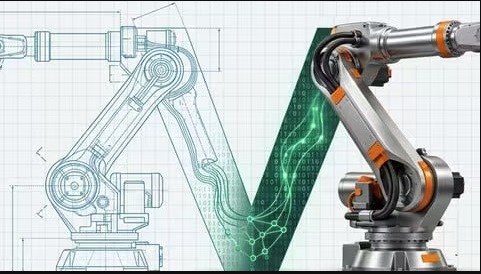
Model-in-the-Loop (MIL) is the first stage of model-based design. In MIL, both the plant (robot) and the controller are simulated as mathematical models before any code is generated or deployed to hardware. This allows engineers to validate algorithms early, reduce development costs, and identify design issues before testing on physical robots.
---
## Learning Objectives
By the end of this course, you will be able to:
* Explain the Model-Based Design (MBD) workflow.
* Understand the role of MIL in robotics development.
* Build mathematical models of robotic systems.
* Design and tune controllers in simulation.
* Validate controller performance using simulation results.
* Prepare models for later Software-in-the-Loop (SIL) and Hardware-in-the-Loop (HIL) testing.
---
# Module 1: Introduction to Model-Based Design
### Topics
* What is Model-Based Design?
* Robotics development lifecycle
* MIL vs SIL vs PIL vs HIL
* Benefits of simulation-first development
### Learning Outcome
Understand why engineers simulate robots before building them.
---
# Module 2: Mathematical Modeling
### Topics
* Dynamic systems
* Differential equations
* State-space representation
* Transfer functions
* Kinematics vs Dynamics
### Robotics Examples
* DC motor
* Differential drive robot
* Robotic arm
* Inverted pendulum
---
# Module 3: Robot Modeling
### Topics
* Coordinate frames
* Homogeneous transformations
* Forward kinematics
* Basic inverse kinematics
* Motion equations
### Practice
Create a mathematical model for a two-wheel mobile robot.
---
# Module 4: Building the Plant Model
The **plant model** represents the robot itself.
Include:
* Motors
* Wheels
* Sensors
* Friction
* Battery effects
* Robot mass and inertia
---
# Module 5: Controller Design
Topics include:
* Open-loop control
* Closed-loop control
* PID control
* Feedforward control
* State feedback (introductory)
### Example
Control robot speed using a PID controller.
---
# Module 6: Sensor Modeling
Simulate:
* Wheel encoders
* IMU
* GPS
* LiDAR (basic)
* Camera delay (concept)
Consider:
* Sensor noise
* Sampling rates
* Latency
---
# Module 7: Environment Modeling
Create simulated environments featuring:
* Obstacles
* Slopes
* Different floor surfaces
* Wind (for aerial robots)
* Friction variations
---
# Module 8: Simulation
Evaluate:
* Step response
* Overshoot
* Rise time
* Settling time
* Stability
* Tracking error
Run simulations under different operating conditions.
---
# Module 9: Verification
Ask questions such as:
* Does the robot reach its target?
* Is the controller stable?
* Are safety limits respected?
* Is power consumption acceptable?
---
# Module 10: Preparing for SIL
Learn how to:
* Validate model assumptions.
* Improve model fidelity.
* Organize models for automatic code generation.
* Transition to Software-in-the-Loop testing.
---
# Practical Labs
### Lab 1
Model a DC motor.
### Lab 2
Control motor speed with a PID controller.
### Lab 3
Model a differential-drive robot.
### Lab 4
Follow a straight-line trajectory.
### Lab 5
Follow a circular path.
### Lab 6
Avoid static obstacles.
### Lab 7
Tune PID gains for improved performance.
### Lab 8
Add sensor noise and evaluate robustness.
### Lab 9
Compare multiple controller designs.
### Lab 10
Complete an integrated robot simulation project.
---
# Recommended Software
* MATLAB & Simulink
* Simscape Multibody
* Simulink Control Design
* Gazebo (for robotics simulation)
* ROS 2 (Robot Operating System)
* CoppeliaSim
* Python with NumPy, SciPy, and Matplotlib
---
# Assessment
* Quizzes (20%)
* Lab assignments (40%)
* Final simulation project (40%)
---
# Final Project
Develop a simulated autonomous mobile robot that:
* Follows a predefined path.
* Detects and avoids obstacles.
* Uses noisy sensor data.
* Maintains stable motion under varying conditions.
* Demonstrates satisfactory control performance through simulation metrics.
---
# Skills You Will Gain
* Mathematical modeling
* Robot dynamics
* Control system design
* PID tuning
* Simulation and validation
* Sensor modeling
* Plant modeling
* Performance analysis
* Model-based design workflow
* Preparation for SIL and HIL testing
---
# Suggested Learning Path
1. Model-in-the-Loop (MIL)
2. Software-in-the-Loop (SIL)
3. Processor-in-the-Loop (PIL)
4. Hardware-in-the-Loop (HIL)
5. Deployment on real robotic hardware
6. Field testing and optimization
This progression reflects the standard workflow used in many robotics and embedded systems projects, helping reduce development risk by validating designs incrementally before deploying to physical robots.
Код:
https://www.udemy.com/course/course-1-model-in-the-loop-mil-for-robotics/?couponCode=KEEPLEARNING






 Course 1: Model-In-The-Loop (Mil) For Robotics