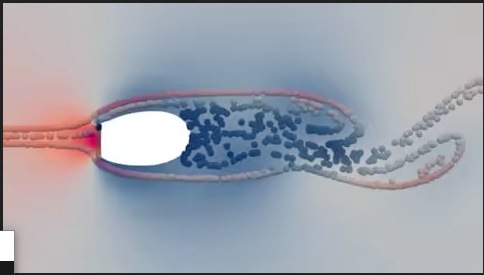
 Mastering Lagrangian Particle Dynamics In Openfoam
MP4 | Video: h264, 1920x1080 | Audio: AAC, 44.1 KHz
Language: English | Size: 2.50 GB | Duration: 2h 10m
Learn Euler-Lagrangian CFD, particle tracking, coupling, DPM, and MPPIC with hands-on OpenFOAM simulations
Understand the fundamentals of Euler-Lagrangian particle modeling in CFD
Set up and run Lagrangian particle simulations in OpenFOAM
Work with one-way coupled solvers for particle tracking in precomputed flows
Implement two-way coupling between particles and fluid flow
Configure particle injection, forces, and interpolation schemes
Model particle-wall interactions (rebound, escape, absorption)
Simulate surface film behavior with mass and momentum exchange
Apply DPMFoam to include particle volume effects in the flow
Set up MPPIC simulations for dense particle flows without pair-wise collision tracking
Visualize and analyze results using ParaView and interpret particle-laden flow behavior
Requirements
Basic understanding of fluid mechanics (velocity, pressure, conservation laws)
Introductory knowledge of CFD concepts (mesh, boundary conditions, discretization)
Familiarity with OpenFOAM basics (running simple cases)
Comfortable using a Linux/terminal environment
Basic experience with ParaView for visualization (helpful but not required)
Description
This course provides a complete and structured journey into Lagrangian particle dynamics using OpenFOAM, guiding you from fundamental concepts to advanced dense particle flow modeling techniques used in real-world CFD simulations.In many engineering applications-such as sprays, aerosols, particle-laden flows, and multiphase systems-the interaction between a continuous fluid and dispersed particles plays a critical role. Traditional CFD approaches often focus only on the fluid phase, but modern simulations require capturing the behavior of particles as well as their interaction with the flow. This course is designed to bridge that gap by teaching you how to model such systems using OpenFOAM's Euler-Lagrangian framework.We begin with the fundamentals of particle tracking and build a strong conceptual understanding of how Lagrangian methods work. You will explore how particles are represented as parcels, how their motion is governed by physical laws, and how they interact with the surrounding fluid. Instead of relying on isolated theory, every concept is tied directly to implementation within OpenFOAM, ensuring that you gain both theoretical clarity and practical capability.As the course progresses, we move into one-way coupled simulations using solvers such as icoUncoupledKinematicParcelFoam. Here, particles evolve in a precomputed velocity field, allowing you to understand particle dynamics without feedback into the flow. This step is essential for building intuition before introducing more complex coupling mechanisms.From there, the course advances into two-way coupled simulations using kinematicParcelFoam. In this stage, particles not only respond to the flow but also influence it through momentum exchange. You will learn how source terms are introduced into the governing equations and how this changes the behavior of the system. The interaction between particles and fluid becomes more realistic, and you will begin to see how such simulations are used in practical engineering problems.A major highlight of the course is the introduction of surface film modeling. This allows you to simulate particle-wall interactions in a physically meaningful way, including phenomena such as bouncing, absorption, and splashing. These effects are critical in applications like spray cooling, coating processes, and combustion systems. You will understand how thin film models are integrated into the Euler-Lagrangian framework and how mass and momentum exchange occurs at boundaries.Once the foundation in dilute particle flows is established, the course transitions into more advanced territory with DPMFoam. This solver introduces the concept of particle volume fraction, allowing you to account not only for forces but also for the physical space occupied by particles. In many real-world systems, particles are not negligible in size, and their presence affects the available volume for the fluid. You will learn how this modifies the governing equations and how to interpret the resulting flow behavior.The final and most advanced part of the course focuses on dense particle modeling using the Multi-Phase Particle-in-Cell (MPPIC) method. In dense flows, tracking every particle collision becomes computationally infeasible. MPPIC addresses this challenge by replacing explicit collision tracking with statistical and continuum-based models. You will explore how particle properties are projected onto the Eulerian mesh, how stresses are modeled, and how velocity corrections ensure stable and realistic simulations.The course carefully explains the building blocks of MPPIC, including averaging methods, damping models, isotropy corrections, and packing models. Each concept is connected to its implementation in OpenFOAM, and you will also examine the source code to understand how these models are structured. This deep dive into the codebase is particularly valuable for those who want to extend or customize solvers for their own research or industrial applications.Throughout the course, emphasis is placed on hands-on learning. You will set up multiple simulations from scratch, modify dictionaries, run solvers, and visualize results. These practical exercises ensure that you are not just passively learning concepts but actively applying them. By the end of the course, you will be comfortable working with different Lagrangian solvers and choosing the appropriate approach depending on the physics of the problem.Another important aspect covered in the course is post-processing and interpretation of results. Understanding how to visualize particle trajectories, velocity fields, volume fractions, and interaction effects is crucial for extracting meaningful insights from simulations. You will learn how to use tools like ParaView effectively to analyze both Eulerian and Lagrangian data.The course also addresses common challenges and pitfalls encountered when working with particle simulations. Issues such as numerical instability, incorrect boundary conditions, unrealistic particle behavior, and solver configuration errors are discussed in detail. You will gain practical strategies to debug and improve your simulations, making your workflow more efficient and reliable.A key strength of this course is its focus on clarity and structure. Instead of overwhelming you with complexity from the beginning, concepts are introduced step by step, with each lecture building on the previous one. This makes the course suitable for learners who want a systematic understanding of Lagrangian CFD rather than fragmented knowledge.In addition to the video lectures, comprehensive course notes and fully prepared case files are provided. These resources allow you to follow along easily, replicate simulations, and experiment with variations. Having access to ready-to-run cases significantly reduces setup time and helps you focus on learning the concepts and techniques.By the end of the course, you will have developed a strong understanding of:How Lagrangian particle tracking works in CFDHow particles interact with fluid flow in different coupling regimesHow to simulate dilute and dense particle systemsHow to configure and run advanced OpenFOAM solversHow to interpret and analyze particle-laden flow simulationsMore importantly, you will gain the confidence to approach complex multiphase problems and design your own simulations tailored to specific applications.Whether you are working on academic research, industrial projects, or simply looking to expand your CFD skillset, this course equips you with the tools and understanding needed to model particle-laden flows effectively using OpenFOAM.
Students and researchers in CFD, mechanical, aerospace, or chemical engineering,Engineers working on particle-laden flows, sprays, or multiphase simulations,OpenFOAM users who want to learn Lagrangian particle modeling in depth,Professionals looking to move from basic CFD to advanced multiphase simulations,Anyone interested in understanding dense particle modeling (DPM, MPPIC) in practical applications






 Mastering Lagrangian Particle Dynamics In Openfoam