 Aerospace Engineering: Complete Drone Guide
Published 4/2026
Created by Samir Seyid Ali
MP4 | Video: h264, 1920x1080 | Audio: AAC, 44.1 KHz, 2 Ch
Level: All Levels | Genre: eLearning | Language: English | Duration: 22 Lectures ( 8h 6m ) | Size: 7.1 GB
✓ Introduction to Drones and UAV
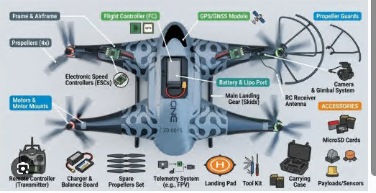
✓ Main Drone Components
✓ How Drones Fly (Flight Physics)
✓ Drone Cinematography and Applications
✓ Types of Drones
✓ Drone Regulations and Responsible Flying Essentials
Requirements
● Basic physics knowledge (High school level)
● Basic algebra knowledge (High school level)
● Basic chemistry knowledge (High school level)
● A little bit imagination and logic
 Description
Hello dear student, and welcome to my course: Aerospace Engineering: Complete Drone Guide.
Drone technology is evolving at an incredible pace, and modern unmanned aerial vehicles (UAVs) are now used in everything from aerial photography and delivery services to surveillance, agriculture, mapping, and advanced research. Behind every stable, efficient, and responsive drone is a carefully engineered balance of aerodynamics, propulsion, control systems, and flight dynamics.
In this course, I will introduce you to the fascinating world of drone engineering - the science and engineering principles that allow multirotors, fixed-wing drones, and hybrid UAVs to fly, hover, maneuver, and perform complex autonomous tasks.
Whether you're a complete beginner or already have some experience with drones or aerospace systems, this course is designed to help you build, strengthen, and expand your understanding of UAV design and performance. If you're new, you'll gain a solid foundation in how drones generate lift, maintain stability, and respond to control inputs. If you already have experience, this course will help you deepen your knowledge and apply it to real-world drone engineering challenges such as efficiency optimization, flight stability, and autonomous navigation.
In this course, we will cover
• The fundamentals of drone flight, including lift generation, thrust, drag, weight balance, and how multirotor and fixed-wing UAVs achieve controlled flight
• Drone stability and control systems, including pitch, roll, yaw dynamics, and how flight controllers maintain balance in real time
• Propulsion systems, including brushless motors, propellers, ESCs, and how design choices affect thrust and efficiency
• Aerodynamics of drone frames and propellers, and how design influences flight endurance, speed, and maneuverability
• Flight dynamics, sensors, and control algorithms, including IMU systems, GPS stabilization, and autonomous flight behavior
• Real-world drone applications in delivery, mapping, inspection, agriculture, cinematography, and emergency response systems
We will break each topic down into clear, structured, and easy-to-understand sections. Step by step, you will learn how aerodynamic forces, control systems, and propulsion work together to keep drones stable, responsive, and efficient in flight.
By the end of this course, you will
• Understand the core engineering principles behind drone flight and UAV systems
• Be able to analyze key drone components such as propellers, motors, frames, and flight controllers
• Gain the ability to understand and troubleshoot common drone stability and performance issues
• Develop a strong foundation for advanced studies or careers in drone engineering, robotics, aerospace systems, or autonomous vehicle design
If you're passionate about drones, robotics, aviation technology, or want to become a UAV engineer, flight systems designer, or drone developer, this course is designed for you.
So don't wait-join the course and take your first step into the exciting world of drone engineering and autonomous flight systems. See you inside the course!
Who this course is for
■ This course is designed for anyone with an interest or passion in aviation and drone technology, regardless of their background or prior experience.






 Aerospace Engineering: Complete Drone Guide