 Don't Get Upstaged
Published 6/2026
MP4 | Video: h264, 1920x1080 | Audio: AAC, 44.1 KHz, 2 Ch
Language: English | Duration: 2h 10m | Size: 1.45 GB
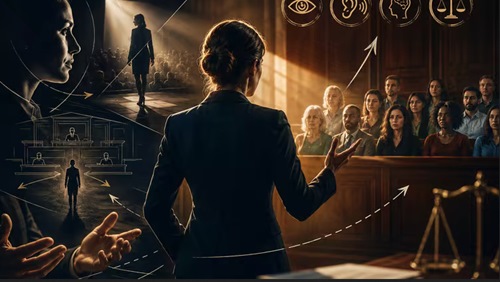
Staging in the Courtroom for Lawyers
What you'll learn
Analyze how principles of theatrical staging and movement can be applied in the courtroom to enhance persuasion, credibility, and juror engagement.
Demonstrate the use of purposeful body movement, positioning, and spatial awareness to reinforce key themes and transitions during trial advocacy.
Identify the relationship between nonverbal communication, physical presence, and audience perception, and apply techniques to align body language with advocacy
Evaluate how courtroom atmospheres, status dynamics, and environmental influences affect juror decision-making, witness presentation, and attorney performance.
Requirements
No pre-requisites.
Description
Studies show that only seven percent of what we communicate are our spoken words. As much as 93% of what we communicate is
nonverbal . Our bodies are our
frontline of expression. It's what everyone sees. There is no hiding it.
Every gesture has enormous implications in telling a story, and the courtroom is no exception. The jury can see your whole body in the courtroom, so you might as well be aware of what it's doing and use it to say everything that you mean it to say.
This presentation contains a flesh blend of theater, psychology, and the law. In it, we'll cover the following topics
· Nonverbal Communication;
· Unity of Opposites;
· Syncing Nonverbal Communication with Verbal Communication to tell an unforgettable story;
· Economy of Movement; and
· Movement in the Courtroom.
By the end of this course, students will be able to do the following
-
Analyze how principles of theatrical staging and movement can be applied in the courtroom to enhance persuasion, credibility, and juror engagement.
-
Demonstrate the use of purposeful body movement, positioning, and spatial awareness to reinforce key themes and transitions during trial advocacy.
-
Identify the relationship between nonverbal communication, physical presence, and audience perception, and apply techniques to align body language with advocacy goals.
-
Evaluate how courtroom atmospheres, status dynamics, and environmental influences affect juror decision-making, witness presentation, and attorney performance.
-
Apply concepts of rhythm, pacing, and storytelling drawn from theater and performance arts to create more compelling and memorable courtroom presentations.
-
Recognize the connection between physical movement, emotional state, and persuasive communication, and utilize movement techniques to improve authenticity and presence.
-
Employ principles of economy of movement to eliminate distracting behaviors and ensure that gestures and physical actions support rather than detract from the advocate's message.
-
Develop strategies for empowering jurors, humanizing clients, and leveraging courtroom status dynamics to strengthen persuasion and improve trial outcomes.
Who this course is for
Lawyers
Psychologists
Law students
Mock trial students






 Don't Get Upstaged